TEMPO.CO, Jakarta - A number of videos claiming that the rupiah must be weak for Indonesia to progress have been shared by social media accounts such as Instagram [archive], Facebook, TikTok, and YouTube since mid-May 2026. The videos circulated amidst the weakening rupiah exchange rate against the United States dollar (US$).
The videos featured explanations from content creator Benny Batara Tumpal Hutabarat, also known as Bennix. One of them was posted on Bennix's Instagram account on January 28, 2026. He stated that the weakening rupiah exchange rate against the US$ would encourage Indonesians to innovate to meet domestic needs without importing.
He cited news reports that US President Donald Trump had also stated that he wanted to weaken the US$ to win export competition against China. "So, if you're thinking rationally, if you want your country to progress, we should even weaken our own currency," Bennix said in the video.
Is it true that the rupiah must weaken to achieve advanced economic status in Indonesia?
FACT CHECK
Tempo verified the content by comparing it to credible information and interviewing economic experts. The results showed that the weakening rupiah actually increases the economic burden on the government and the people.
I Wayan Nuka Lantara, a lecturer at the Faculty of Economics and Business (FEB) at Gadjah Mada University (UGM), stated that to achieve advanced economic status, Indonesia cannot rely on currency depreciation. A country's progress is determined by productivity, innovation, and the quality of its human resources.
Wayan said the dollar exchange rate, which reached Rp 17,300 in May 2026, then skyrocketed to Rp 18,200 on June 8, 2026, resulted in expensive imports, rising prices, rising inflation, and declining purchasing power.
The weakening rupiah also increased the government's burden as the value of foreign debt paid in US dollars increased. "Similarly, energy and food subsidies increased," Wayan told Tempo on Monday, June 8, 2026.
Weighted National Price (HNT) data from the Ministry of Trade showed that the price of imported soybeans on June 11, 2026, rose 1.04 percent, from Rp 13,581 to Rp 13,722 per kilogram compared to the previous month.
The most severe price increase was felt by the people of Maluku, at 12.50 percent.
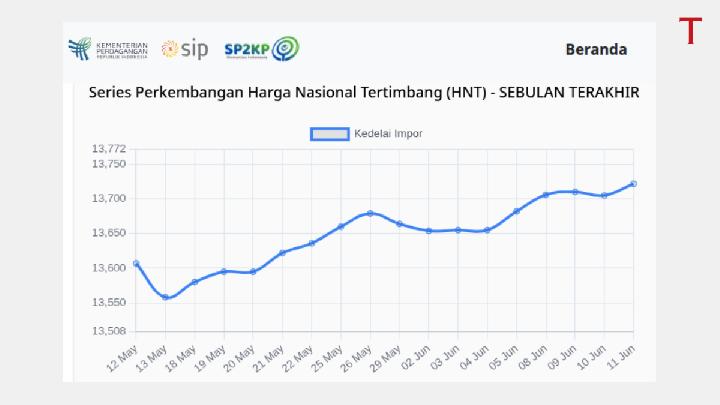
Data on weighted national prices for imported soybeans from the Ministry of Trade, May-June 2026.
Wayan said the rupiah's depreciation had a domino effect on fiscal pressures. Furthermore, the performance of Indonesia's Composite Stock Price Index (IHSG) was the worst in Asia and even globally. The IHSG is one indicator of global investor confidence in a country.
Comparative data from Indonesia's IHSG with four neighboring countries shows a very sharp decline. According to Yahoo Finance, Indonesia's IHSG fell 15.31 percent in just one month, despite rising consecutively in the last two days.
Meanwhile, Thailand's IHSG rose 4.48 percent, Singapore's rose 0.11 percent, the Philippines' fell 1.49 percent, and Malaysia's fell 4.20 percent.
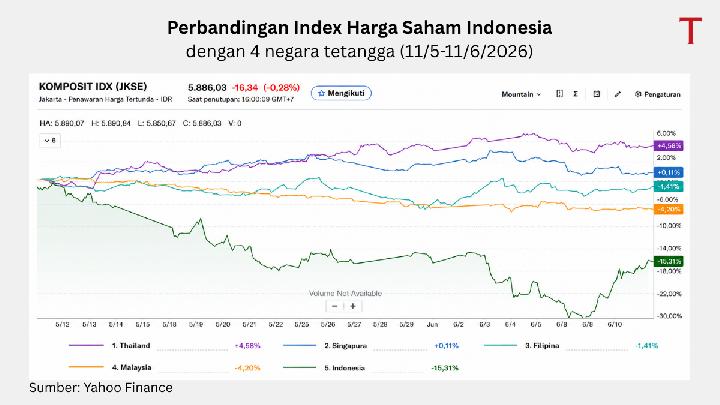
Comparison of the Composite Stock Price Index (IHSG) of four neighboring countries, May-June 2026.
Indonesia Doesn't Need to Follow Trump's Lead
I Wayan Nuka Lantara said Indonesia cannot emulate Trump's move to weaken its currency. This is because Indonesia still relies on imports of raw materials and energy.
If the rupiah is deliberately weakened, he said, it will actually backfire on the national economy, increasing inflation and instability. This situation differs from the stronger economic capacities of the United States and China, which would weaken their domestic currencies.
Moh. Najikhul Fajri, a monetary economics researcher at Diponegoro University (Undip), explained that an economic strategy of deliberately weakening a currency requires thorough preparation. This preparation includes increasing exports that are in demand by the market and being smart about dealing with competitors.
However, according to Fajri, Indonesia's exports have not yet met the requirements due to the large volume of imports. "Indonesia is not a producing country, and the volume of imports and exports is almost equal," Fajri told Tempo on Tuesday, June 9, 2026.
With a large import posture, the strategy of weakening the rupiah actually has a negative impact because producers will purchase raw materials at higher prices. As a result, the prices of basic necessities also soar.
Another consequence is that the debt will increase and fiscal space will shrink due to the financing of fantastic programs such as free nutritious meals. Tempo attempted to contact Bennix via the Facebook page's messaging feature and the numbers on his social media accounts. However, as of Friday, June 12, 2026, he had not responded.
CONCLUSION
Tempo's verification concluded that the narrative that the rupiah must weaken if Indonesia wants to become a developed nation is a misleading claim. Deliberately weakening the rupiah will backfire on the national economy by increasing inflation and instability. This contrasts with the stronger economic capacities of the United States and China, which would weaken their domestic currencies.
TEMPO FACT CHECK TEAM
**Do you have information or claims that you want to have fact-checked? Contact our ChatBot. You can also send criticism, objections, or feedback for this Fact-Checking article via email to [email protected].