TEMPO.CO, Jakarta - J.P. Morgan Indonesia stated that the 2027 State Budget (APBN) reflects a constructive balance. The financial services firm, part of U.S.-based JPMorgan Chase, believes this balance strikes a middle ground between sustaining economic growth and maintaining fiscal discipline.
"Amid ongoing global uncertainty, Indonesia's economic resilience, strong domestic liquidity, and various ongoing reform efforts remain the foundation for long-term growth potential," JP Morgan Indonesia CEO Gioshia Ralie said in a written statement quoted on Friday, September 4, 2026.
Under the macroeconomic assumptions for the 2027 draft state budget, the government targets economic growth of 6.0 percent and inflation at 2.5 percent. Meanwhile, the exchange rate is projected at Rp17,500 per U.S. dollar, with 10-year government bond yields expected around 6.9 percent.
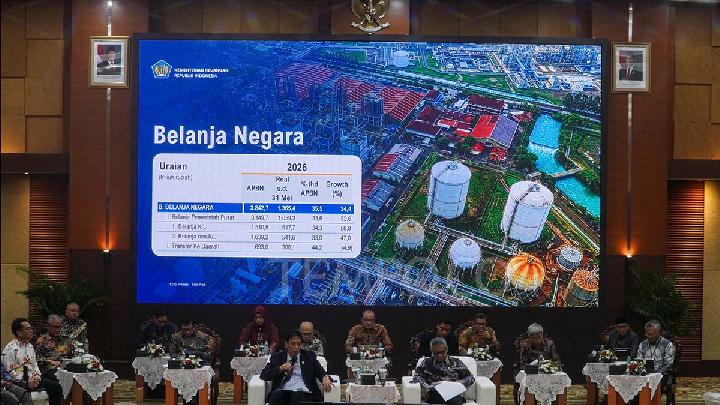
State revenue in the 2027 draft budget is targeted at Rp3,426.0 trillion, marking a 6.8 percent increase from the previous year. This figure comprises tax revenue of Rp2,908.0 trillion, non-tax state revenue of Rp517.4 trillion, and grants totaling Rp700 billion.
State expenditure under the 2027 draft budget is planned at Rp4,097.2 trillion, up 3.9 percent from the previous year. This allocation includes central government spending of Rp3,362.2 trillion and regional transfers of Rp735.0 trillion.
On the financing side, the 2027 budget deficit is targeted at Rp671.2 trillion, or 2.40 percent of Gross Domestic Product (GDP). This figure marks a reduction from this year's target of Rp689.1 trillion, or 2.68 percent of GDP.
According to Gioshia, the lower fiscal deficit target signals a cautious fiscal stance. However, over the medium term, the declining ratio of state revenue to GDP and an escalating interest payment burden remain key challenges for Indonesia's fiscal outlook.
"In general, a more conservative fiscal stance can help dampen volatility in Indonesia's stock market and exchange rate," he said.
On the other hand, Gioshia noted that substantial non-interest and subsidy spending indicates sustained support for key programs. However, the government may be forced to scale back subsidies if global energy prices surge.
Gioshia stressed that sustained growth in Indonesia will depend on the efficiency of public spending and larger private sector investments. "It depends on the effectiveness of government spending and the ability to attract larger private investments through foreign direct investment (FDI), deregulation, and non-budget complementary funding," he said.
In the medium term, Gioshia noted that private sector investment will serve as the primary growth driver. Furthermore, fiscal resources have been channeled into priority sectors. Enhanced spending efficiency, foreign direct investment, and regulatory reforms are seen as vital avenues for attracting private capital.
"Investments from SOEs and Danantara can complement central government spending, helping broaden the capital base needed to support higher growth," he said.
Finance Minister Purbaya Yudhi Sadewa previously noted that the global economy in 2027 is expected to face continued high uncertainty. While global economic growth is projected to improve, it will still encounter structural and cyclical risks that weigh on overall performance.
"The world economy in 2027 is expected to navigate complex dynamics with high levels of uncertainty," he said during a working meeting with the House of Representatives Budget Committee in Jakarta on Thursday, August 27, 2026.
Nevertheless, the former Chairperson of the Indonesia Deposit Insurance Corporation (LPS) Board of Commissioners emphasized that Indonesia's economy remains resilient and demonstrates solid fundamentals. In the first half of 2026, Purbaya added, the economy expanded by 5.45 percent year-on-year. This growth was driven by household consumption, rising investment, and supportive government policy.
According to Purbaya, fiscal policy and the state budget are vital tools for safeguarding stability. "Fiscal policy and the state budget strategy are crucial to maintaining macroeconomic stability and realizing prosperity for all Indonesians," he said.
Purbaya noted that the 2027 draft budget aims to foster higher growth through economic and fiscal strategies centered on eight national priority clusters. These eight programs include food security; energy and water self-sufficiency; education; healthcare; downstreaming and industrialization; infrastructure, housing, and disaster resilience; rural and grassroots economies; and poverty reduction.
In 2027, Purbaya assured, the government will maintain the health, credibility, and sustainability of the state budget. "[This will be achieved] through enhanced state revenue, higher quality and more efficient spending, as well as innovative, prudent budget financing," he said.
Read: Bank Indonesia, Govt Set Timeline for Fund Withdrawals in State Banks
Click here to get the latest news updates from Tempo on Google News